Showing posts with label Our Family Values. Show all posts

Sunday, 25 February 2018

Finding Balance in Healthy Eating // Dessert Night


Something tells me this teddy-bear jar is going to feature heavily in my kid's childhood memories, haha!

Friday night around here is 'dessert night'.

It kinda speaks for itself, I guess, and needless to say, is a pretty popular night on my kids' weekly calendar!

A couple of years ago we instituted the tradition of 'Friday Night Dessert Night'.  We try to eat pretty healthfully around here - I try to avoid refined sugar and processed food in my family's daily diet. However, as the kids (currently 5, 7 and 9) were getting older and more aware of all the food out there that their peers enjoy, bringing home lolly bags from parties and all of that, they started clamouring for  treats and desserts! What to do, what to do!? While I make a lot of healthy food treats (just ask my kids' school friends, apparently I am very well known for my healthy brownies and muffins, lollllll) the kids soon became familiar with the more sugary and processed alternatives. Whose idea was it to let them out of the house?! ;)

While we certainly talk a lot about good food and healthy eating habits and all of that (see this post on our general family food approach and tips for creating healthy eaters) I felt like total restrictions and putting a blanket ban on all junk food wasn't ultimately going to help with building a lifelong healthy relationship with food. Extreme restrictions might be more likely to lead to the kids going overboard on junk food either as teens or just whenever given opportunity out of my sight! Plus, I just didn't want to be so uptight ALL the time, it's not fun being the food police!! Even though I do what I gotta do for my kid's health, sometimes it's just fun to have a treat without over thinking it and while I want them to be conscious eaters, I also don't want them to get paranoid, know what I mean? Ha! It's a fine balance, huh? It's been really wonderful to see them learning to self-regulate and often stop eating a slice of sugary cake half way through, announcing 'My tummy says that's enough'. I wish my own tummy had always been so self-aware!!!

So, I try to follow a general 80/20 rule for our family. 80% whole and nourishing foods, 20% just eat whatever you want, no stress or guilt. Because life and food are also just for enjoying and celebrating and being in community too, you know? I don't want to be too uptight. Sometimes I feel we swing too far one way or the other but that's life, huh?! When we do, I just try to steer the family back on course without beating myself (or them, lol) up.

Anyway, back to Dessert Night!!

It works well for us because the kids know not to ask for junk food at any other time, but they also know they have a treat outlet once a week! It's a healthy (ha!) boundary for our family. So I am not a total killjoy who always says 'no' haha (last week when I served up ice-cream I did declare - 'see, I can be fun!!'). But also so that the treats don't become too pervasive in daily life. Yes, we still do party food, treats with friends at social events, ice creams etc when we are out occasionally too. But 'dessert night' helps us keep in a healthy routine at home and with our daily eating.

The kids know they aren't totally 'missing out' but they also appreciate and generally want to eat healthfully too. I hope it's the kind of pragmatic balanced approach and habit they might choose to keep up throughout their lives. I love that they are getting to know their own bodies and often times won't even eat all of their dessert before recognising they are full!

As for what we have? Sometimes I make something more elaborate, a proper dessert or even ice cream with sprinkles (or a healthy version of a 'treat' too which they usually love just as much!), but more often than not, the kids just want to select two items from the fabled 'lolly jar' where all the random sweets and chocolates from party bags etc get dumped. I sometimes try to do it Friday afternoon  rather than after dinner, gives the sugar more time to burn off ;)

So, that's 'our family way'. Certainly not the only or 'right' way to handle healthy eating in the home, but just sharing it as a strategy that is working well for us! It gives us balance. Not total restriction but not a free-for-all either!!! It sure does save a lot of negotiations too, the kids know not to debate it, if they want a treat they know when they can have it!

These family 'policies' work differently for every family or even in different seasons but this seems to be the 'sweet spot' (pun intended!) for us in finding a balanced approach to our family's healthy eating.

Now, I better go check the 'lolly jar' stocks!!! ;)


Wednesday, 15 June 2016

Five Ways to Make Family Mealtimes More Meaningful


Family dinners.

Is it something you grew up with? I did. I guess it's one of those things where you assume it's just 'what everybody does', until my friends staying for dinner in my teen years started commenting on how different that was....or maybe they meant, how different/weird my family was?!?! Who knows, haha!

Family mealtimes weres something Mark and I wanted to continue when we had our own kiddos. Baby led weaning helped make that a natural transition even when the kids were tiny as they could feed themselves, and so easily joined the family table. And yes, dinner time slowly crept backwards from 7.30pm to the positively nursing-home time of 5.30pm. Ok, sometimes even closer to five!

Sidenote: eating this early definitely resets your body clock. When friends want to go out to dinner at 7 or 8pm, I am quietly appalled and pretty much gnawing my own arm off by the time that hour rolls around!!! #sad

ANYWAY!


Why family mealtimes matter...

There are all kinds of benefits to family mealtimes. Honestly, the benefits can be far richer and deeper and more long lasting than seem possible in those crazy moments of tired kids, stressed parents, rushed evenings and chaotic dinner scenes. It may seem like there is no way it's so valuable in those moments! Yet there is all kinds of research around the long lasting value of family meals. A regular time to connect as a family, a seemingly simple routine, helps form a sense of family identity that is so powerful!

A short list of benefits to family meal times according to the research (based on eating together as a family 4-5 times a week)...

  • Increased overall sense of family identity and connection
  • Children more likely to do well in school, have a better vocabulary, have greater overall wellbeing, less anxiety, and accept parental boundaries
  • Children less likely to do drugs, be obese, develop eating disorders, and hide things from their parents
  • Children more likely to eat well, with a more varied diet and and a healthy ongoing relationship with food.
  • Children learn conversational skills, develop a greater sense of self and learn how to develop and share opinions.

There are many other benefits, but you get the gist! More simply, it's a time to turn off the media and electronics that pervade our lives, sit down and just talk, deconstruct the day, and plain ol' interact all together in one spot! Kids get so much unconscious comfort from seeing all of their 'tribe' together. Eating together is also great modelling for your children both on meal time manners, etiquette and also healthy eating. Kids who eat with their parents tend to eat more, eat better and end up with healthier eating habits for life ! I could go on and on, but my focus in this post is more on the connection it creates.

Now let's be honest, in the 'early years', family dinner time is not always a tranquil and leisurely affair. Guaranteed at least one person is crying sometime throughout dinner, amiright?? Food is dropped (or thrown). Children run wailing to their beds. Passionate discussions about 'food preferences' (ahem!) are had. And so on... If you live life with little kids, you know the drill!!! All I can say is.... press on. Persevere. Even when it's chaotic, the mere routine of family meals provides a sense of stability and family connection to your children. And it's a chance for them to learn and grow! And in the midst of the chaos, there will be slices of heaven where you will stop and look around the table at your clan and think... 'Wow. My family! How blessed we are!'.

It's just good to be together and to take stock of that. Slowly and surely, the snippets of real conversation, laughter and happy chatter emerge and extend. And you know what?? Even the tantrums, the tears and the challenging behaviours are authentic parts of the fabric of family life too. As weird as it sounds, it's okay that the dinner table is sometimes going to be the training ground for working through some of those tough things. Persevere. It gets better. It takes practise, and that's ok. Slowly you have to get up from the table to fetch things less than 12,533 times!!

Some of your greatest memories will be of moments that organically emerge while gathered around that crumb-strewn family table. They are your people. Mess and all. It's worth it.


A disclaimer (of course).

I totally get that family dinner times are not realistic for everyone. We are blessed that we can make it work for us... my hubby moved jobs a few years ago, largely in order to make sure he could be home in time for dinner with the kids - it was a pretty big family priority for us! But I know that it's simply not realistic or doable for everyone, especially when some parents are not getting home till way past dinner or even bedtime or studying or working at night, etc. But if family meal times sound like a deal you want to get in on, think outside the box to make it work for your tribe. Maybe a family breakfast is more realistic? It may be short and sweet but it would be a great way to start the day together! Maybe weekdays are just too hectic but over the weekend you are able to all gather around a table for every meal? Start with what you can and hopefully it can grow. I've even heard of families where the kids need to eat dinner earlier, but sit at the dinner table again when the working parent gets home, with a drink of milk or some little nibbles, so everyone can chat together while the parents have their dinner. Think outside the box and hopefully you can come up with a workable arrangement :)

If you are committed to making family meal times work for you, I wanted to share a few ideas on how to make that precious time even more meaningful for your family, if and when you feel you are keen to 'build on' to the basics!! I love the idea of maximising this daily ritual. These ideas are all things we do or have done. Not all at the same time, usually!!! ;) Some things might just work for a season. We may do one or two things a night for a few weeks or months, then try something new. Often factoring the age of the kids and how tired we all are too of course. These are things that worked for us. Run with them, and cut them to size for your tribe!

And if nothing else, just eat together. You may all be slurping soup in silence, there may be complaints and squabbles but trust me... the ritual itself has value. Little moments of sweetness will pop up, treasured moments and conversations and family memories will emerge. Even if the only basic requirement is that your whole clan gathers around the table to consume food and beverage, even if it's takeaway or leftovers, it's still worth it. And the more you persevere, the better it will get as everyone comes to accept this 'compulsory family fun' haha!


Five Ways to Make Family Dinners More Meaningful


1. 'Highs and Lows'

This 'game' has lots of different names but I'm sure you know the drill. Everyone around the table takes a turn to share the high and low points of their day. It's a wonderful way to get an insight into everyone's world without having to just ask 'Sooooooooo, how was your day??' (to which the universal response is usually a bland 'Good', right!?). Gotta say, the kids responses to this are usually so fascinating and often comical. It's a great chance to talk through the low points especially and really get a sense of your kid's day. And also so valuable for the kids to see that their parents are people too (gasp!) with their own highs and lows in life - they get a sneak peek into our adult world and can learn from our perspectives and how we handle things.


2. Question Time!

A few months ago, my husband Mark rediscovered an old question game called The Ungame from his childhood, which has card packs of moral and spiritual questions. It's been an fantastic way to bring up topics of conversations we might not usually think of and really gives us some insights to the fascinating worlds going on in our kids heads!

A quick google brings up all kind of question lists for children that you could use to provoke similar questions around the table... these simple questions often provoke deeper conversations and help everyone gain insight into other family members.

(More family dinner questions here and here).


3. The Appreciation Plate

Our Appreciation Plate is brought out on special occasions (birthdays and other celebrations) but I also bring it out every month or two for a few nights when I remember as well - or often the kids request it! You can read more about it here but the basic idea of the Appreciation Plate is that one lucky duck is chosen to eat dinner off the Appreciation Plate that night. While we eat, everyone else around the table takes a turn to say something they appreciate about the person who has the plate.

This has been a beautiful, simple way to build up sibling bonds, with the kids finding ways to tell each other (and us parents!) things they love and appreciate about everyone else in the clan. Really sweet and often powerful to see the things they notice. Building a vocabulary of love, support, kindness and appreciation amongst my children as siblings is super important to me... I want them to know how to tell each other how much they care for each other! For words of kindness to roll off the tongue, it can take practise - it's a skill to be learnt and a mindset to adopt. This is a simple way to start doing this early. Hopefully it continues long after we are gone :)

Also, I got this special plate made because I am a sentimental soul after any excuse for a potential family heirloom, haha! But any old op-shop plate that looks a bit different to the rest of your plates will do the job - hunt down one that is a different colour or pattern or whatever!


4. Get Grateful!

Nothing complicated or groundbreaking... but not something that just has to be saved for American Thanksgiving Dinners either! Go around the table and everyone shares something they are thankful for.

Always good to count (and share!) your blessings.


5. Value Sharing

We are a Christian family, so several of our family table rituals centre around our faith. Firstly, we pray at the start of every meal. The kids usually take turns praying if they want to (they usually want to!). We hold hands around the table, and listen as one of our clan shares a simple message of thanks to God. Then we dig in, often doing Highs and Lows, Ungame Questions or the Appreciation Plate while we eat our meal.

In the last year or so, we have introduced a very short family devotional towards the end of the meal...(like, 5-8 minutes kind of short!). We might sing some Christians songs or more often we read and discuss a Bible story - my husband,Mark reads aloud while leaving gaps in the story for the kids to fill in (loudly!). We find it works well to do this while everyone is 'contained' at the table (rather than waiting till bed time as we used to do... we now keep bedtime just for regular storytime) and then lingering eaters can finish off their food while we all chat. Mark has been wonderfully consistent in keeping this going, and it's been a great addition to our family table. The kids are learning so much and they love it!

Now, if the Christian / religious thing isn't your game, no worries! You might instead like to incorporate your own family values in other ways. You could begin the meal with a simple blessing or even a family motto or special quote (Go Team! haha). You could take turns sharing one thing you are thankful for before eating each night. You could finish up the meal by reading fables or stories with a moral centre that you could then discuss as a family. Always thought provoking! Or read poems! Plenty of options to make it work for your crew and your beliefs.


The Wrap Up...

According to Tolstoy, happy families are all alike... but as much as I love Tolstoy, I happen to think happy families can be quite a bit different! So, at the end of the day, I think it's great to prioritise family meal times, but make them work for YOU - with your own wonderful mix of life circumstances, different ages and family dynamics, different routines and schedules.

We personally might do all or one or none of these elements I've written about each night. Usually at least a couple of them but you know what life is like... sometimes getting everyone fed is success enough! Also, we usually focus on family meals on the week nights, whereas on the weekends we often let the kids eat earlier while we parents eat later as a sort of 'date night in'. I think it's important to recognise that routines can come and go and that is ok - things work well for different seasons and as those seasons of family life change, so too can our rhythms. The kids are at an age now (3, 5, 7) where we have really hit our family meal stride (everyone can sit and chat and participate) and hopefully this will continue - though I know as the kids get older, social/extracurricular lives may be ramping up and it will be harder to get everyone home for dinner together!

Rest assured, we have our fair share of dinner time tears, disruptions and every shade of the emotional rainbow. Trust me!!! ;) But we press on. I've shared some things we do that make our family meal times more meaningful for us. Maybe they will spark an interest in you, to try at your own family table... or simply savour that family meal time just as it is, in whatever way is working for you!

xx Kate


Monday, 2 November 2015

Pocket Money // Choosing the Right 'Allowance Approach' for your Family!


Ah, pocket money!


Kids aren't on this earth very long before they become aware that there is all this wonderful 'stuff' out there and this other thing called 'money' helps you get it. Pretty soon, they connect the dots and start wanting the latter in order to get the former ;) Even if they are pretty oblivious to the wonders of consumerism, it seems that introducing them to financial concepts early just makes sense. Letting kids learn how to 'steward' money while they are young means the risks are lower and they can trial and error with a little parental oversight.

The minute you start thinking about pocket money, (whether because the kids are begging for their own cash, or because you want them to have some), pretty quickly you are faced with a myriad of choices about it. Is the cash a gift or do you tie it to chores? On what basis do you give it or withhold it? What age to start? Do you decide how they spend it or let them have free reign? And of course... HOW MUCH?!!

Pocket money, along with open family discussions around money and finances, allows you to share your family values around money. Though they may not even be intentional, we *all* place some sort of value system around money and spending. And trust me, over time kids are picking up our family values around money - whether we are conscious of it or not! Just think about the sort of money-spending-habits you observed or learnt from your own parents, for example - whether good or bad!? So, it's worth stopping for a second and thinking about what our values around money are, and what lessons we want to pass on to our kids. Like it or not, money affects our life in many ways - whether we choose to highly 'value' it or not, we still have to deal with it! 'Financial literacy' and our perspective on money and spending has a huge impact on how we interact with cash. So, if you are launching into pocket money, it is a chance to consider how to instill the values that are important to *your* family.

Note/Disclaimer! Our kids are only 7, 5 and 2, so we are still in the verrrrry early days of our (expensive) journey with pocket money! To be honest, I felt so overwhelmed at first - so many choices and values and strategies we would like to build in and consider! Then I realised we were best to just start off simply. Our system can (and I'm sure will) change and evolve over time. This post is about how we decided to kick things off - I thought I would share our thought process as to how we got to our starting point - as maybe it will help you too!

I'll give an overview of the main points people might consider with pocket money, and where we personally landed for now. There are a hundred 'right' ways to do pocket money, so feel free to use these just as prompts for your own family discussions and planning - different approaches work for different families :)


This trio of gorgeous kids piggybanks are helping our kids watch their savings grow, right before their very eyes! :)


WHY give pocket money?

Before all the detailed questions comes this key one - what is our goal in giving pocket money? It's not just about the ability to buy 'stuff' is it? As mentioned above, for our family it's about helping our kids learn about the value we place on money. How and why we use it. For our family, money is a tool by which we can bless and serve others, care for ourselves and take care of responsibilities, both now and in the future. 

The management of it, (saving, giving, spending) are ways we apply these values. Pocket money is given to our kids as part of sharing in our family’s wealth and as an introduction to financial literacy. We hope for our kids to learn that money itself has no value, it's not a treasure to seek or store up for it's own sake, but a tool to be used - wisely and generously.

What AGE do you start?

Pick a number, any number! We decided that in our home, pocket money would start when the child starts kindergarten (in Canberra, Australia, that is about 5-6 years old). We find that is about the age when kids start to really understand the value and numerical concept of money, and start being more exposed to the 'outside world' and stuff they want! Before then, we feel they are not really mature enough to manage much cash - and it's ok for them to have a milestone age to look forward if they are hanging out for their own money! Besides, younger kids usually somehow have a few coins floating around so they feel sufficiently cashed up for a few treats till they hit school age! Especially if you have a generous Grandad like ours do... he empties his pockets of change every time he sees them!! Those coins gets eagerly counted then put straight into the kids piggybank until spending time rolls around.


Counting those coins!!


Tie the $$ to CHORES or is it a GIFT?

This is a toughie. I know many parents choose to tie the allowance to chores around the house, under the principle that in 'real life', we need to work to get money so they want their kids to understand that principle early. Getting their pocket money is dependent on completing whatever chores are set around the house within whatever time frame, so kids learn to be responsible and 'get the job done - and in a timely manner' in order to earn their cash. I can really see the sense in this! However, other parents are reluctant to take this approach as they feel everyone in the family should pitch in on chores because that's just what families do - and Mama don't get paid to do the laundry now, does she?! ;)

I can definitely see wisdom on both sides, but we have decided to go with the second approach. The kids have household tasks they need to complete independently of their pocket money. They are members of the household and need to contribute to its upkeep as they are physically able to. We feel strongly that our house is kept running through a contribution of all family members - that is part of the responsibility (and blessing!) of family! So we don't want to get in a habit of paying for them to do chores, or for them to start expecting a cash payment for clearing their plate from the dinner table!! ;)

Even though I appreciate the messages of both approaches, the value of household contribution felt more important to us. We, as the parents, give our kids pocket money as a gift and a blessing. It is a privilege we gift to them as members of our family (and yes, one we can choose to withhold if we decide to for whatever reason, e.g. behavioural, though we have not felt the need to do this so far).


RESTRICT spending or give FREE reign?

Another dilemma! Again, there seem to be two main camps on this one. One approach is to let kids loose with their money, let them do what they want and learn young to either crash and burn or spend wisely! The other approach is to help them be more disciplined with their money from Day One. This approach might mean deciding for them or with them how to spend their money, eg splitting into saving, spending and giving in various proportions. Again, I definitely see the benefits of both approaches! With money comes independence - a privilege to have at a young age!

For now, we have decided to start off with the 'free reign' approach. This is working well because it lets us learn the kids innate spending habits and while they are earning so little, there is not too much damage they can do with it, haha. It also leaves them free to be generous as they see fit which is a principle we personally will always hold to, in that we believe giving should come from the heart, not compulsion. For example, Lily decided recently on her own to give $1 of her money to the collection for the disadvantaged, at church, rather than her usual 50 cents. Or when she chooses to buy gifts for others out of her own money - last year she spent ALL of it on a Christmas gift for her teacher (like, over $30!!!). It is wonderful to see generosity pour out of a child's heart :)

While now it is an interesting experiment to give them this freedom, I think at some point we will introduce more guidelines, encouraging them when they are a little older to think through percentages to save, to spend, to give. While for now 'free reign' is working well, I think it's also a good thing to introduce the thought process and discipline of money management while they are still in the home! While it gives a bit less freedom, they do get to learn how savings can accumulate, how to be disciplined in setting money aside for others and so on.

How to TRACK it?

We had a few failed attempts at trying to introduce pocket money!! The intention was there but the follow through was lacking - and the kids were just as forgetful about it as their parents, haha! Plus we rarely have that much cash around the house. Yes, yes, slackers ;) Then one day I thought to myself... in this day and age - I bet there is an app for that! And you betcha there is an app for that! Heaps! So I went hunting. The best two I found were KiddyBank (it has sliding scales to set for giving, saving etc - and you can even set an interest rate for their savings!!!!) and RoosterBank which lets older kids log in and check what money they have, and also has an easy way to divide up their money for saving, spending, giving. With both, you can also add in extra amounts like birthday money and payment for big chores, etc.

I've tried both and currently use KiddyBank as it's super easy and quick to set up and use (no registration). It has lots of more advanced ways to use it (even emailing spreadsheets to your teens!!) but we just use the basic tracking elements for now. The great thing with an app is that when we are out and about, if the kids want to get something, I can easily check my phone to find out their balance, and deduct what they spend without having to remember to do it later. Let's be honest, we are heading into a cashless society so not a bad thing to get used to this ;) The app helps me remember how to track the bulk of their pocket money, but of course all kids love counting coins too, and still end up with some of the 'real stuff' to fill their piggybanks with!


How MUCH?

That one is very much up to you and your budget! We decided to set the bar low (very low!) as we figure we can always go up but it's not so easy to come down, haha ;) With three kids and many years of pocket money ahead, we kept it basic for now - they don't really need much, after all. Some people use a general guide of $1 per year of the child (eg $5 for a 5 year old), but that seemed a little high for us! ;) Partly this is because our kids don't seem to really want for much - they don't watch TV commercials and rarely go to the shops, so they don't seem to really ask for toys and junk... though they certainly do want an iPad haha, and are making half-hearted attempts to save for one! ;)

As they hit closer to the teen years, I can see us taking the approach where we significantly raise the pocket money while also giving them more responsibility to use it for things like paying for the school canteen, gifts, outings with friends, clothes etc. I can see a lot of benefits in this approach because they get to learn to budget for real life expenses early, while still being able to use our guidance.

It's wonderful to see children's financial independence emerge. When we are out somewhere special, I love to see the kid's pride when they want an ice cream and decide to buy it for themselves (with our approval). Suddenly they take an interest in which one is the most and least expensive because they are on their own dime! ;) It's fascinating to see them struggle between the instant gratification of spending a little money a lot, versus delaying gratification by saving up for a bigger or more special item. Of course, this is often highly emotional processing, especially when they realise they can't buy something because they already spent all their cash!


Sooooo, that's my wrap up on pocket money! There are lots of variables to consider, and it can take some thinking through to find an approach that feels right for your family - hopefully this post might give you some starting points for discussion!

As I said, we are at the starting gates, so would love for you to please share your pocket money approaches, lesssons and learnings in the comments, for my and other reader's benefits :)

xx Kate


Finlee & Me is one of Australia's best websites, full of quality goodies for babies, kids and parents! You can find out more about the excellent products they stock on their website, or follow them on Facebook or Instagram

Finlee &Me kindly gifted us these gorgeous kids piggybanks, which are clearly being put to good use! I've been looking for a quality piggybank for ages (where the kids could SEE the money and where it wasn't either too hard or too easy to get the money out - these tick those boxes and more, cos they are so cute too!). I love the design - fun and functional and look awesome in the bedroom of a toddler *or* a teen... Let's be honest, I'd have one in the loungeroom for my own savings, they are such a gorgeous, modern yet classic design! We love them - thanks, Finlee & Me! (All opinions 100% my own, of course!)


Sunday, 15 February 2015

how to deal with tattling - with two simple phrases!


You hear it, don't you. At a certain age, it suddenly starts to emerge....

'Muuuuuuuum, ABC is doing XYZ!!!'

Now, our kiddos usually operate as a team so we didn't hear tattling for a good long while... but then 'suddenly' up it cropped. Um....how are we gonna handle this one?! My husband and I quickly realised we needed to think about an intentional and firm 'family policy' on how to handle this little thing known widely as....

Tattling.

When Sibling A tells the parents that Sibling B is (allegedly!) up to no good.

Why? Possibly because...

a) They hope to get them 'in trouble'
b) They are genuinely distressed/concerned about what is happening
c) They are taking too much responsibility for their sibling's behaviour
d) All of the above?!

So where does that leave the parents? Suddenly corralled into investigating all sorts of mischief that may or may not have happened as described. You obviously didn't witness the indiscretion, so it makes it rather tricky (and time consuming!) to get to the bottom of things.

And where does that leave the siblings? Split apart and ready to 'pounce and renounce' their beloved brother or sister in order to 'get them in trouble' or whatever the motive may be. Sometimes, yes, it's genuine distress, worry or dismay. But something doesn't feel right about kids running to 'tell' on their siblings throughout the day.

Tattling just doesn't seem like a good habit for our kids to get into, does it?

However, we don't like to tell our kids just what not to do - we want to give them strategies for dealing with these issues themselves.When a new issue crops, my hubby and I like to step back and chat about where we think the behaviour is coming from and how to best approach it. This helps us be intentional in our approach and working together with a 'game plan' tends to make us more consistent (ahhhh, the rub of parenting - consistency!). We thought about our goals for our children's relationship with each other. How we felt about behaviour that was 'not okay' going on in our home and us not knowing about it. How we also felt about being constantly pulled in to investigate and adjudicate over events we hadn't actually witnessed.

Some of the elements we wanted to consider for our family policy on 'tattling'... (dot points in an attempt to be brief!)...

  • Just saying 'No tattling' didn't seem realistic. While we don't want our kids to tattle, there are situations we do need to know about... you know, for health and safety and burning houses and whatnot ;) 
  • We want our kids to see themselves as a team. A sibling team: friends who look out for, support, protect and encourage each other - not bringing each other down. I want our kids to have each other's backs when launching into the big wide world. It is so important to me, to nurture those sibling bonds.
  • We want our kids to want each other to make good choices, to hope for each other's best. 
  • We do not want to be told about every minor misdemeanor and spend all day refereeing. They needed tools for dealing with things themselves.
  • If our kids are making a bad choice and we are not aware of it, we've decided it's pretty much 'between them and God' if you know what I mean. I don't need to micromanage every misdeed. Any character issues will surely come to light at other times, in ways I personally witness. It's more important to us to nurture the sibling relationship than to pit them against each other as tiny power crazed police! If they are flicking the lights on and off or getting out of bed when asked not to, and I don't see it myself, that's ok. In the end, our parenting is about engaging our children's hearts and moral development long term, which unfolds in more ways than getting out of bed one time. 
  • I DO want to be told about behaviour that is dangerous (harming or likely to harm themselves or others, like hitting siblings, preparing to jump from the top bunk or playing with matches) or destructive (harming property, like drawing on the walls or ripping up a book).
  • We want our kids to understand that they cannot control the actions of other people and they are not responsible for other's bad choices. This is one of life's lessons it took me a loooong time to learn so I want to get this one in early! If they see someone making a bad choice, I want them to encourage them to make a better choice, but without feeling like they must control the other person or be responsible if they continue. I want them to know I don't hold them to account for that - even the older siblings.

We then came up with two simple phrases to help guide the kids and ourselves through a potential tattling situation. Of course, we sat the kids down first and talked with them about our expectations and explained what these phrases mean.

Sooooo -

When a child comes running to me saying 'Mum, Mum, ABC is....'

I calmly stop them and first ask 'Is it dangerous or destructive?' 

If yes, I immediately go and investigate and deal with as necessary.

If no, I ask 'Have you encouraged them to make a better choice?'

If 'No', I suggest they go and gently encourage their sibling (eg 'ABC, remember that Mum said to stay in bed!'. But I remind them that they can't force them and they are not responsible if their sibling chooses not to obey.

If 'Yes' - I say 'I am glad you are trying to help your sibling. That is a loving choice, helping them do the right thing. You don't have to control what they do, if they don't listen, they are responsible - not you.'

At this point their intention usually becomes clear. If perhaps they were hoping to throw their beloved sibling under the bus, (!!) they walk away realising that I'm not playing that game. If they seem genuinely distressed then it's an opportunity to comfort them and talk about choices and personal responsibility. We chat about using our words (and not our hands!) to encourage others to make good choices.

We can't police our children 24/7, even if we did want to... (a good time to insert the phrase 'Ain't nobody got time for that!' Haha!). We take our kid's character development extremely seriously as parents, but part of this is recognising that at the end of the day, parenting is not about controlling every behaviour but about reaching their hearts and helping transform the attitudes behind their behaviour.

This approach aims to preserve and encourage sibling bonds, to save our sanity, and to have a consistent 'line in the sand' about what issues we intervene in and those we won't. I don't want our kids to be tempted to be 'tattletales'. Our family policy is an intentional choice, knowing you have to win some and lose some. They say in parenting you pick your battles and we hope this is a case where we miss some minor battles in order to gain victory in a greater war - their hearts and their relationships.

The kids now know where we stand and feel empowered and also relieved (especially our oldest, who tends to feel responsible for her younger siblings behaviour, which is a burden too great for a kid to bear, I think!). Tattling is now at a minimum and we have a 'policy' in place to help guide us all when it does emerge. I am thankful to see the sibling bond continue to grow and strengthen as my kids encourage each other to make good choices, without being burdened to either 'tattle' or control others.

So, those two simple phrases? In case they got lost in my rambling (TL:DR!?), in summary they are - when your kids come running to you to tattle on a sibling, simply ask -


Is it dangerous or destructive?

Have you encouraged them to make a good choice?


I hope this technique is helpful to your family or at least a prompt to consider your own family approach to tattling :)

xx

'So then, let us always aim for those things that lead to peace and help strengthen one another' 
Roman 19.19


Thursday, 3 April 2014

a family celebration plate // appreciating you


A little dream and a loooong hunt finally accumulated in this little item arriving in the post this week...


(Sorry about the dodgy asterisks! I try to keep my surname off the blog)


A 'family celebration' plate was something I started looking for a couple years ago. I thought it would be easy to find but hours spent (over a year!!!) trawling the interwebz intermittently still brought me up empty - at least in the style, size and material I wanted. Finally, after digging and digging through the wonderland that is Etsy, I found Tanya at Zinnia Designs who does custom ceramics - and I liked her style! I contacted the lovely owner and asked if she could custom make the plate I saw so clearly in my mind's eye. She said yes and was just wonderful to work with, patiently bringing my vision into fruition! :) It was a long and winding road with some (postal) hiccups along the way, but at last this precious little gem arrived! And I love it!! Ain't it pretty? Very simple, just as I wanted. I now have some hesitation in actually using this precious thing, but indeed we must!

My hopes/plans for this little plate are two fold...

Firstly - a Celebration Plate. I want to create a family tradition of pulling out this lovely plate for times of celebration. Not only for birthdays, but also first days of school, various achievements, milestones, to simply recognise character development, and so on. In our family we love to celebrate each other and this little plate will be a lovely visual way to do that habitually. Whoever is being celebrated gets to eat from this plate during our family dinners, and bask in the glow of adoration from the rest of their family ;)


My second hope/plan is to use it as an Appreciation Plate. 

This idea certainly does not require a fancy dish! If you want to try this too, any old plate from an op-shop or wherever could do, you just want a plate that looks a bit different to the rest of your dinner plates. I got the concept from a very dear family whom I stayed with a few times in Minnesota, USA - many moons ago now, when I was single and childfree! This family of five are a wonderfully godly, loving and hospitable clan who gave me many visions of what I hoped my own family life might be some day. (And now here we are - wow!). I still have such fond memories of my days spent in snowy Minnesota!

One ritual they had was using an 'appreciation plate' each night at dinner. This 'special red plate' got rotated around the whole family (parents included) and whoever got the plate each night, the rest of the family would say something they appreciated about that person. Yeah, even as a nineteen year old, my heart just melted into a big old puddle, seeing young siblings saying kind things to each other. I even got to have the plate one night and was so touched by the kind and cute things the kids said :) I tucked that sweet idea away and here we are years later, with kids of my own who are finally old enough to start playing along! I don't expect we will do this every night forever, but more so as something we will bring to the table (ha!) for seasons as we feel the need.

It's a little hard to read, but 'Bind us together, Lord' is inscribed on the back. Mark and I have these words
engraved inside our wedding rings. Now almost a decade later, they are engraved on this family treasure. Wow - God is good. He is what binds us so tightly. The words are from a beautiful hymn we sing at church and have always loved. 'Bind us together, Lord, with cords that cannot be broken. Bind us together, with love'. Amen to that!

When I think about the skills I want to help develop in my children, one strong theme is to help them be fluent in communicating - fluent in appreciation, genuinely building up, resolving conflict, and sharing authentic feelings. This little nightly ritual will be another tool to help build up that skill. As we all know, sibling relationships (well, all family relationships!) can be fraught with tension, hurt feelings, and the wearing down from the nitty gritty of daily life together. Through all that, I want my children, our family, to be still comfortable in being able to say to each other 'This is what I appreciate about you. This is what I love about you. This is what I like about you. This is a strength I see in you.' Too often these good things can go unsaid, whilst harsh words and criticism flow freely!! :(

I hope that by giving the kids plenty of practise now, it may stretch those little hearts for use in many years to come. I want us all to be comfortable speaking this language of encouragement. For tender and uplifting words to roll easily from our tongues - not to feel awkward in speaking kindness to those we love the most. And not only between siblings! I want them to practise showing appreciation for their dear ol' parents ( we are people too!). I want to make a regular habit of showing them how much we (their parents) also appreciate them. And hey - the kids even get to see Mummy and Daddy show appreciation to each other!  Yah, it's a regular appreciation-fest, I think you get the gist, no need for a diagram, haha ;)

We have started to introduce this little routine to our nightly family dinner table in the last few nights. For all my grand ideas, of course the kids have even better ones! After the family went around and said things we appreciated about Eli and were about to move on, he piped up and said 'Wait, it's my turn!!'. Well, I wasn't sure what he meant but then he proceeded to say something he appreciated - about himself!!!!!! LOVE IT. Why not? Why not give them space to stop, reflect and share a strength they can recognise about themselves! (He said he did a good job cleaning up his room that day). The next night when it was Lily's turn she squealed when she saw the plate at her seat. She was so thrilled and felt so special. After we all said our things about her (Eli told her she did a good job cheerfully trying a new dinner she was unsure about - it was so cute!), and it was time for her to do herself, she was like 'Oh, there's so many things I like about myself!' then rattled off four things. Oh, the unbashed self-confidence of children, lol!!!


Yes, yes, I am a sentimental soul, no doubt!! Mock if you will! ;) But I am just so happy about this simple little plate. And more than a mere plate, I am grateful  for God's blessing of family and thankful for little traditions and rituals that bind us ever closer. When it comes to my family, there is so very much to appreciate and celebrate... and during the hum drum, exhausting, challenging or just 'arrgghhh' kind of days, I don't want any of us to forget that. We are richly blessed to have one another.


PS If you come over to dinner, you will get the Appreciation Plate! xx


Wednesday, 21 August 2013

Sibling Relationships // How to reduce the Fighting with 'Soft Words'


As I wrote about recently, we have been working on a little 'family values' poster project. 

Our next value (mmmm, maybe value isn't exactly the right word here, but you catch my drift!) was 'Speaking Gently'

In family life, *how* we speak to each other often becomes just as important as *what* we say (ever noticed that?!). Recently I'd noticed that the tone of the interactions between Lily and Eli were sometimes getting a little 'sharp and squealy' for my liking! The high-pitched/whiny 'Stop!!! Move away!! I was playing with that! Noooo, don't touch, that's mine!!' type thing. Ahhhhh, like nails on a chalkboard, huh!? ;) Generally, they play/negotiate/discuss and get along sooooo well, but I had started to notice this type of 'sharp' response creeping in and really wanted to nip it in the bud before it became a standard for their interaction. I totally understand those responses are so instinctual when you feel 'wronged' but I also feel like with practise and purpose, we can train ourselves to slow down and respond differently out of a 'new habit' - and perhaps turn the whole interaction around. A big call for little hearts but a good one to begin working on early before those sharp response patterns become entrenched. Creating consciousness in them about how they were speaking, as well as showing them a 'better way' would be the first step. This is where 'scripting' often comes in, but I will write about that in another post!

What I noticed in particular was how things would escalate so often not from the initial statement or action (by Child A) but from the response (by Child B) at which point, things could get really 'heated'. So I wanted to work on 'cutting that circuit'.... just with baby steps, as I understand that negotiation and self-control are skills that must be learned over time (and often take a lifetime to fine-tune, as I sadly know too well!).

So with all those thoughts churning around, I figured 'speaking gently' would be a good subject for us to focus on next. I had a Proverb in mind to use along with it that has always struck me for its wisdom and real-life applicability. It applied especially well to the case of 'sibling-interaction-escalation!' (and, it should be noted, parent-child-interaction too!! Ahem).


''A soft answer makes anger disappear,
 but a rough answer makes it grow.''
Proverbs 15.1

I compiled a couple of translations to use the words that were most understandable to the kids... I loved this translation as the 'soft/rough' words were so graphic and clear - and I loved the visual of our response making anger either grow or disappear! This is a scripture full of such truth and wisdom - so very powerful! 

I looked around online for an activity as I thought such a core concept could use something extra to help the kids really understand the difference they could make with their words and even their tone. I found this simple and sweet one to base my own activity on -  I loved how it made soft and rough words so real!

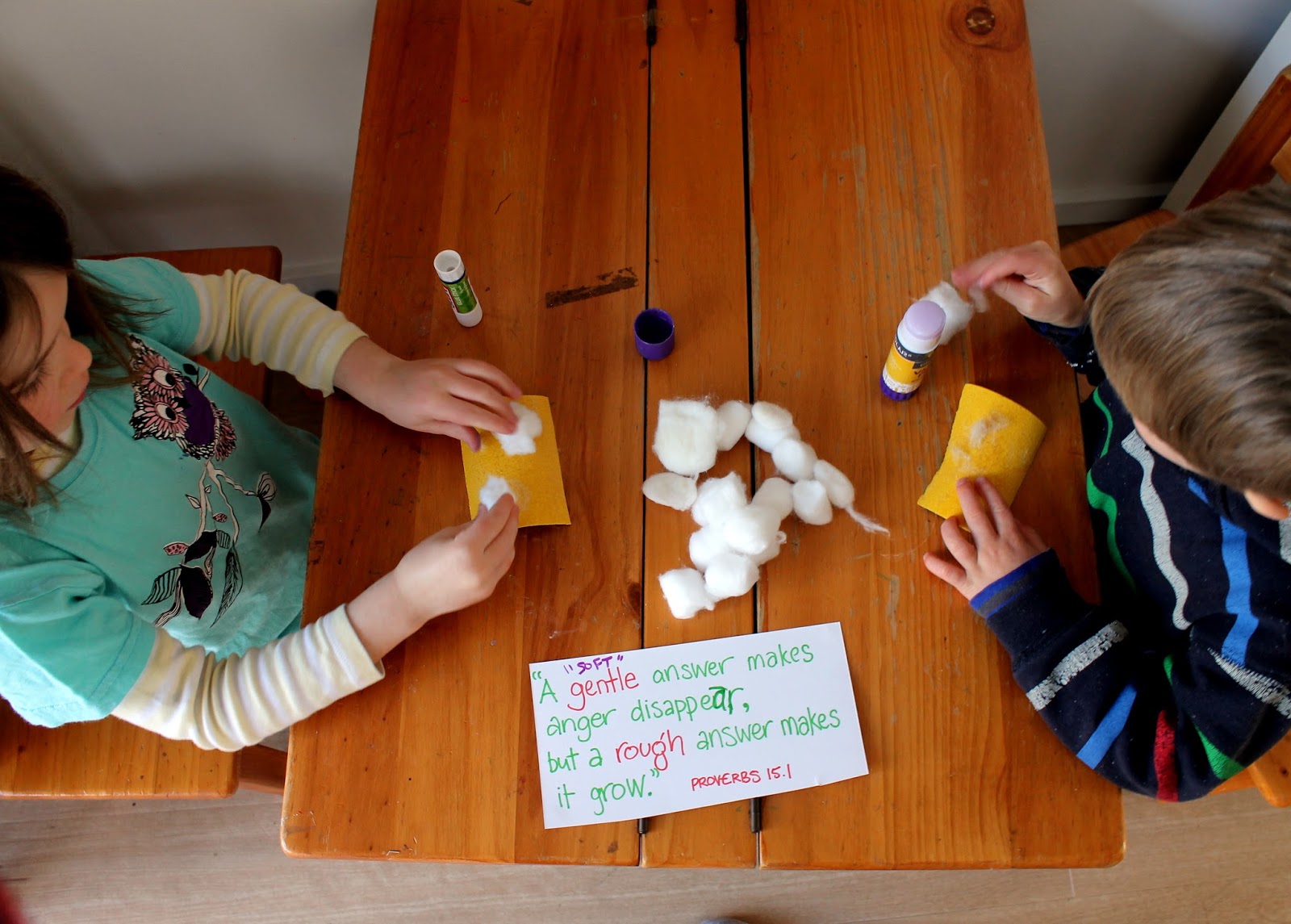
We cut out some little sheets of sandpaper and got a pile of cotton balls and glue. The kids and I had a chat about our words and how we could use them in different ways in our family. We read the verse together and I explained to the kids how rough words and soft words could make someone feel by encouraging the kids to rub either the sandpaper or cotton ball on their bare arms. How does it feel when someone uses rough words with you? (It hurts me!) How does it feel whens someone uses soft words (nice and gentle and soft!). We had quite a fun (and funny!) time having pretend conversations where someone would answer in a rough way (ouch!!) or a soft way (ooh, that feels nice!). They really got into it and we laughed as we role played. I could see they were really understanding the concept and getting a lot out of it too. We walked through how, even if someone said/did something a little bit rough, we could choose to respond 'softly' and that would 'cover up' the rough words (or, 'put out the fire', if you will) and make things so much better! Sometimes it is better not to fight fire with fire... if you don't want to burn your home down, right???


For example:

Eli: (grabs a toy -  - may or may not realise L was using it)
Lily (calmly): Eli, I'm still using that right now, please can you give it back to me? You can have a turn in a minute, ok? (soft - rub that nice cotton ball!)

Eli hands it back. Done :)

 - as opposed to -

E: (grabs a toy - may or may not realise L was using it)
Lily (frantically): NOOOOOOOO, Eli!! That's mine! Give it back!!!! 

(rough - scratchy sandpaper!)

Eli holds on to toy for dear life! Problems escalate!

I should note here that of course, ideally 'Child A' would not snatch, complain or whine in the first place! And we talked about and work on that too. But when Child A makes a bad choice, it is certainly a lot easier to deal with that behaviour if Child B does not escalate the situation! (So Mama then has two upset kids to deal with!). Plus as we have seen, a soft response can often totally diffuse a potential melt down and avoid needing intervention too, so they can negotiate and work out issues more independently.


We reenacted quite a few *familiar* scenes using both rough words and soft words so they could see the difference those words could make. The key I think is realising that THEY can change the direction themselves, by choosing to calm themselves and use softer words - instead of immediately 'arking up' with rough words that only make the situation worse. They especially loved it when I tried out using some rough words too (wailing over wanting a toy, haha) so they could hear what it sounded like to me for once!! ;) 

Afterwards, they glued the cotton balls to the sandpaper, to remind us that God wants us to use soft words with each other, and that our soft words will help 'cover up' any rough/angry words and help them go away. We stuck them up on our little 'family command centre', but the kids still like to take them down to use every now and then! 

Later that day, when Lily responded cheerfully and obediently to a request I made, she pointed to the little cotton ball craft and said 'I bet that felt really soft to you, Mummy!'  It sure did! :)

Since then, using phrases like 'Try using some soft words', 'That sounded a bit like rough words to me'  and 'Do you think that feels soft or rough?' have been good reminders to slow down and watch words and tone. I've noticed both of them (unprompted) sometimes stop just as they are about to get upset, take a breath and instead use gentle words with each other - which is just gorgeous and such a relief to see!!! And they see for themselves the difference this makes!

Of course, it's not all soft and cosy cotton balls around here!! ;) They are still learning and so am I. It's a process but this little project has been a good reminder to dig deep into understanding the power of choice that we have. One little craft activity is absolutely not a one-fix-wonder, but it helps to understand big concepts in a very concrete way about the impact their words can have. This little activity also hit the nail on the head in terms of my strong belief in 'training in times of non-conflict'. Of course, that takes a little extra energy, initiation and creativity from me too - I don't always have the resources to do this but I just do what I can, when I can - focusing on one key area at a time really helps make it more manageable. They are so much more open to grasping these concepts when we talk about them when not in the midst of a melt down or argument. Instead everyone was relaxed and happy and open to receiving these words into their little hearts. It takes us all back to the foundations and refreshes us all to aim higher, do better and keep learning together.


Later I was reflecting on how it went and feeling thankful that they understood so well. But as I pondered, that proverb cut through my own heart - as God's Word tends to do!! I mean, God's Word and that verse is not just for kids!! It was speaking to me too. How often (and how easy!) is it for me to respond 'roughly' to someone, especially when I feel like they have spoken roughly to me?! With my kids most of all - if they are whiny, cranky or argumentative, how tempting it is to respond in kind with a frustrated, sharp or cranky voice? How much better do things go if I respond calmly, lovingly, empathetically (but still firmly)? Much, much better.

Of course, the kids are not the only people in my world (just the ones who take up most of my time, haha!). The same goes for my dear husband, my extended family, the grumpy shop assistant and so on. Even when I don't get spoken to or treated exactly how I would like, I have a choice in whether to escalate or diffuse the situation. A harsh response can stoke the fires of anger, but a soft word may douse it completely and turn the situation around... especially if it's just someone else's hard day, tired moment or even good old miscommunication stirring up things. It's funny how often in this world we get the idea that we should fight fire with fire - if someone speaks to us unpleasantly, we should volley it back to them. God turns it upside down when He encourages us to instead respond with softness. It's so easy to see the flaw in an angry response when I see it in my kids. It's so much easier to justify that response in myself!!!!

I am blessed to regularly see how a gentle response works through my own wonderful husband, Mark. He has a great habit of responding gently and compassionately, rather than 'firing back'. If it's me being cranky or frustrated, it immediately melts me and helps me realise he is not 'the enemy' but rather I am usually just tired/stressed/worried about something else. I see him work his magic on others too :) I admit I am more likely to 'fire back' when seemingly attacked by someone (oops) and have learnt so much from his gentle ways of responding.

Food for thought indeed. God's word is so rich and I love how something can be found in it for every age and every stage!


Mmmm, can you seem what word I almost (horror!) misspelled? If only I was
fussy enough to re-do the whole thing but I just could not be bothered ;)

Anyway, we all learnt a lot as you can see from this little activity and Family Values lesson. It will be a looooooong work in progress for us all, but it is encouraging to be on the same page, reaching for the highest standard. We fail, we fall, we grump and we return fire with fire. But we also slowly learn to cover roughness with softness and when we do, we all reap the good results of a more respectful and harmonious home and life. We can forgive when we fail and encourage each other to do better. That's what family is for... we are a graceful learning ground for life :)


Thursday, 15 August 2013

our family values // a little poster project

What are your core family values? 

This is something I have been thinking about lately. Our values form such a central party of our family identity. I have been so charmed by an array of lovely Family Values or Family Rules posters I have seen on Etsy or Pinterest, and was even tempted to buy one - I thought it would be great to have up in our home. But none of them felt like they perfectly fitted our family and I didn't just want to buy into someone else's. So a few weeks ago, I decided to spur of the moment to simply pop up a sheet of paper on the wall so we could start building our own. Rather than overwhelming the kids (and myself) with a big list all at once, I thought we'd just slowly develop the list step by step. 

What would go on the list? I decided to begin with whatever 'values' that I wanted the kids to learn about, focus on or particularly (ahem!) needed a bit of assistance in working on! It would then naturally turned into a bit of a Family Theme around the home for a while too. I also wrote the word on another little poster stuck up on a wall for reference (along with a Bible verse or explanation) while we focused on it. An unexpected side benefit of this was that it helped *me* as well as the kids really focus on that value for a while - we could all highlight it in daily home life and really learn it in a much deeper way. Sometimes doing a small craft, activity and/or role play to explain it a bit more helped it all sink in too. We have only got through three 'values' so far and as we deal with the obvious ones, I may go looking around for more ideas on things to include too - suggestions welcome!!


This little nook is developing into a bit of a central family planning
and learning corner!


We started off with 'Helpfulness' - a good intro as the kids are already very helpful and I knew could also understand it easily and of course grow. We all had fun highlighting any acts of helpfulness we saw from each other, and it opened our eyes to how everyone in the family could help each other in big and small ways. We talked about why we help each other and how it feels when someone helps you. It was lovely and the kids really grew in not just their understanding of helpfulness but also in doing it more spontaneously. They became more aware of ways they could help, and even more aware of the help their wonderful parents gave too! ;) I got a few more ideas of small tasks around the home they could do for an increased sense of their very important contribution to our family (side bonus is decreasing the load for me!). Eli would find things on the floor and then as he put it away, say coyly, 'Dat's helpfulness, Mummy!' Haha, yes indeed! 

 'Respect' was all about treating every member of the household as an individual and as a person worthy of honour. Everyone is precious to God and deserves to be respected! Our theme Bible verse was 'Treat others as you would like them to treat you' from Luke 6.31. Even little Baby Miles can be treated with respect  - by not invading his personal space, not squashing him with cuddles or rattling toys in his face too vigorously without warning. (Ummm, can you tell this kid get a lot of loving?!!). Small things like talking to Miles about what is happening to him before picking him up were ways the kids became more aware of showing him respect. The kids learnt a lot about showing respect to each other in their play and interactions. Of course, respect for us as parents as we raise them was a big focus too. This has always been such an important thing to me, that my children will learn how to show (and feel) respect for us as parents - not just in behaviour but also in speech and tone... and most importantly, from their heart where it all flows! It is also our aim as parents to show respect to them too, so we also had stuff to work on! Though we have authority and must set boundaries and train and give consequences and all that, we always aim to do so respectfully, with empathy and gentleness. Yeah, it's a work in progress for ALL of us! ;)

I will write up a separate post about how we learnt about 'Speak Gently' as we did a fun little activity to accompany that one - coming soon(ish)!


Lily wanted to help colour in the words


It started on a bit of a whim but now I am so pleased that this little project has turned into something quite intentional and foundational for our family. The kids love to read through the poster and tell visitors about all the values. It's still all pretty flexible still - no fixed or regimented program on how we are doing it as I am just not that organised or strict!  So we will introduce a new value when I feel like the previous one has been well understood and worked on, and/or when I get the energy to introduce another element!!  It's roughly been every couple of weeks so far, but some I suspect will be needed for much longer! ;) Of course, I should clarify that going through this one time does not mean it's checked off or understood for life or anything! This little project is just another thin layer in the foundation we are working to build - piece by piece instilling the things that God values into the hearts of our children. Not merely to build their characters but to bring them closer to knowing and understanding who God is, too. 

I thought I would share this here in case it inspires anyone else to do this in their family! Your values might look different (as every family is!), but whatever they are, I think it's just a nice way to think them through and share and grow in those core ideas together :)